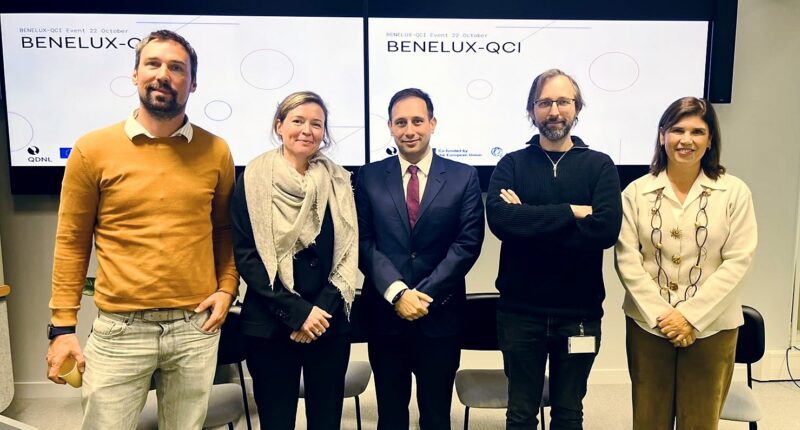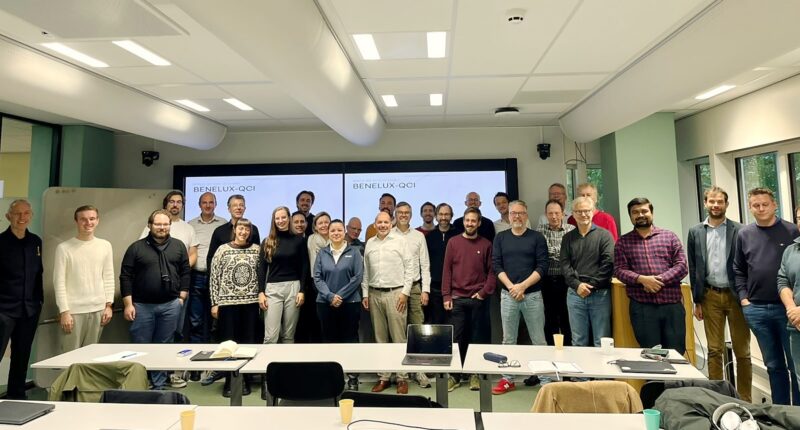
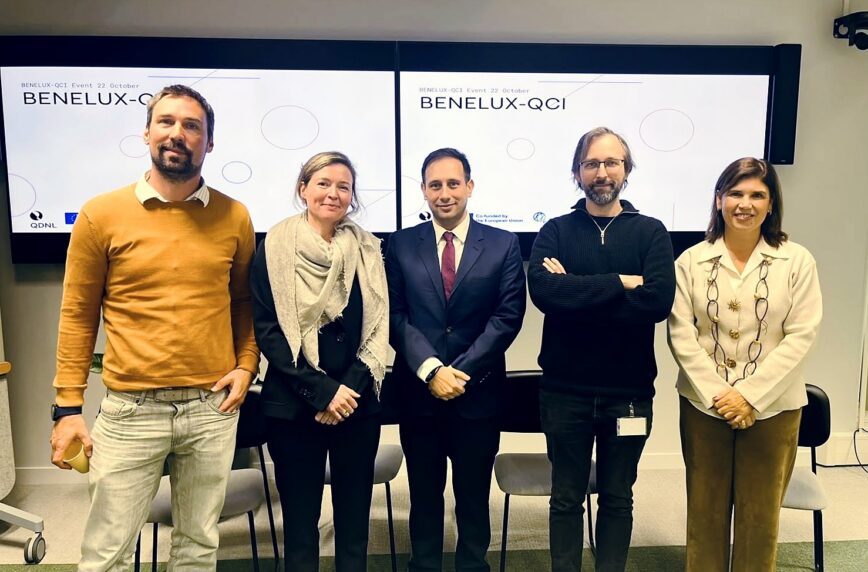
SEEWQCI, coordinated by GRNET, participated in the BENELUX-QCI Event, held on 22 October 2026 at the premises of SURF in Utrecht, the Netherlands, represented by Dr. Ilias Papastamatiou, Senior Project Manager and Technical Lead Net/Quantum at GRNET and Coordinator of SEEWQCI, and Petros Papapetropoulos, Project Manager at GRNET.
The event brought together representatives of European quantum communication initiatives, research and education networks, and other stakeholders to discuss developments in quantum communications, cross-border interoperability and the future of the European Quantum Communication Infrastructure (EuroQCI) initiative.
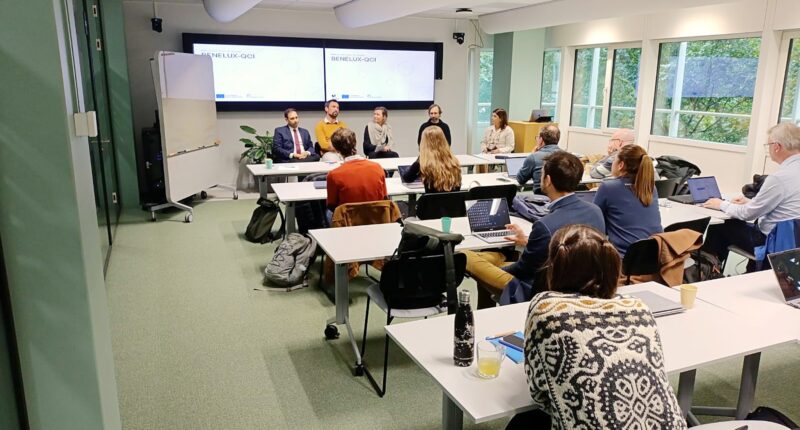
Dr. Papastamatiou participated as an invited speaker in the panel discussion “The Future of EuroQCI”, alongside Niels Deriemaecker (Belnet), Charlotte Postma (TNO) and Wojciech Kozlowski (SURF). Moderated by Cristina Cerioni (QDNL), the panel explored the next steps for EuroQCI, focusing on the transition from national Quantum Communication Infrastructure (QCI) deployments towards cross-border demonstrations and operational Quantum Key Distribution (QKD) services.
During the discussion, Dr. Papastamatiou highlighted the strong potential for European cooperation through the complementary roles of SEEWQCI, TransEuroOGS and BENELUX-QCI, describing them as a valuable triangle of collaboration. With the Netherlands participating in SEEWQCI and Luxembourg in TransEuroOGS, these initiatives create important opportunities for Key Management System (KMS) interoperability, joint cross-border demonstrations and terrestrial–satellite integration, supporting the broader objectives of EuroQCI.
Building on the significant progress achieved through national QCI deployments across Europe, Dr. Papastamatiou stressed the importance of connecting national infrastructures through cross-border demonstrations. These efforts represent an important step towards operational QKD services and the practical implementation of quantum-secured communications across borders.
The discussion also addressed key challenges in the development of EuroQCI, particularly end-user engagement and cross-border cooperation. Dr. Papastamatiou underlined the need to involve users from the outset, understand their operational requirements and develop reliable, usable quantum-secured services that can be integrated into existing communication environments.
Another key topic was the role of European National Research and Education Networks (NRENs), including GRNET, SURF, Belnet and Restena. Drawing on their expertise in networking and cross-border connectivity, these organisations actively contribute to EuroQCI, foster collaboration across Europe’s research and education networking community and support the development of interconnected quantum communication infrastructures.
The event also provided an opportunity to engage with representatives of TNO, a key SEEWQCI consortium partner, including Charlotte Postma, Teun van der Veen and Soumya Das, reinforcing partnerships within the European quantum communication ecosystem.
SEEWQCI’s participation in the BENELUX-QCI Event reaffirmed the importance of coordinated European efforts to advance interoperable, cross-border quantum communication infrastructures. Together, SEEWQCI, TransEuroOGS and BENELUX-QCI, supported by European NRENs and project partners, contribute to the transition from national QKD deployments towards practical, reliable and operational quantum-secured communication services within the EuroQCI framework.
More information about the event is available on the SURF website here.